The 40th Wizz Air Venice marathon, run on Sunday 25 October, answers a question most city destinations never have to ask: what does a race add to a place that is already full of visitors? In Venice the answer is direction. Registration closed months early at a record 24,000 runners across three distances, 55% of them from abroad and 70%in the marathon itself. The organisers expect the local economic impact to pass 15 million euros. And the course does not start in Venice at all. It starts at a villa on the Riviera del Brenta and spends most of its distance in the places day visitors never see.
Forty years, 24,000 runners and a floating bridge.
The numbers came from the official press conference on 20 October at the M9 Museum in Mestre. Of the 24,000 entries, 10,200 were for the marathon; the rest ran the half marathon and a 10K. The international share averaged 55% across the three races and reached 70% in the 42K. The general coordinator, Lorenzo Cortesi, said the impact on the local area is expected to exceed 15 million euros, and that a dedicated study and conference will follow.
The route is the interesting part. The marathon starts at Villa Pisani in Stra, which also hosts the pre-race services, and follows the Riviera del Brenta past its Venetian villas through Stra, Fiesso d'Artico, Dolo and Mira. It then crosses regenerated urban areas in Marghera and central Mestre, runs past the M9 Museum and through San Giuliano Park, and only then takes the long Ponte della Libertà into Venice. From there it runs along the Zattere to Punta della Dogana, crosses the Grand Canal on a 166-metre floating bridge built for the race by the municipality, does a lap of Piazza San Marco and finishes on Riva Sette Martiri. The expo, with more than 100 exhibitors, sat in Mestre, not on the islands. The race was broadcast live on Rai Sport and RaiPlay.
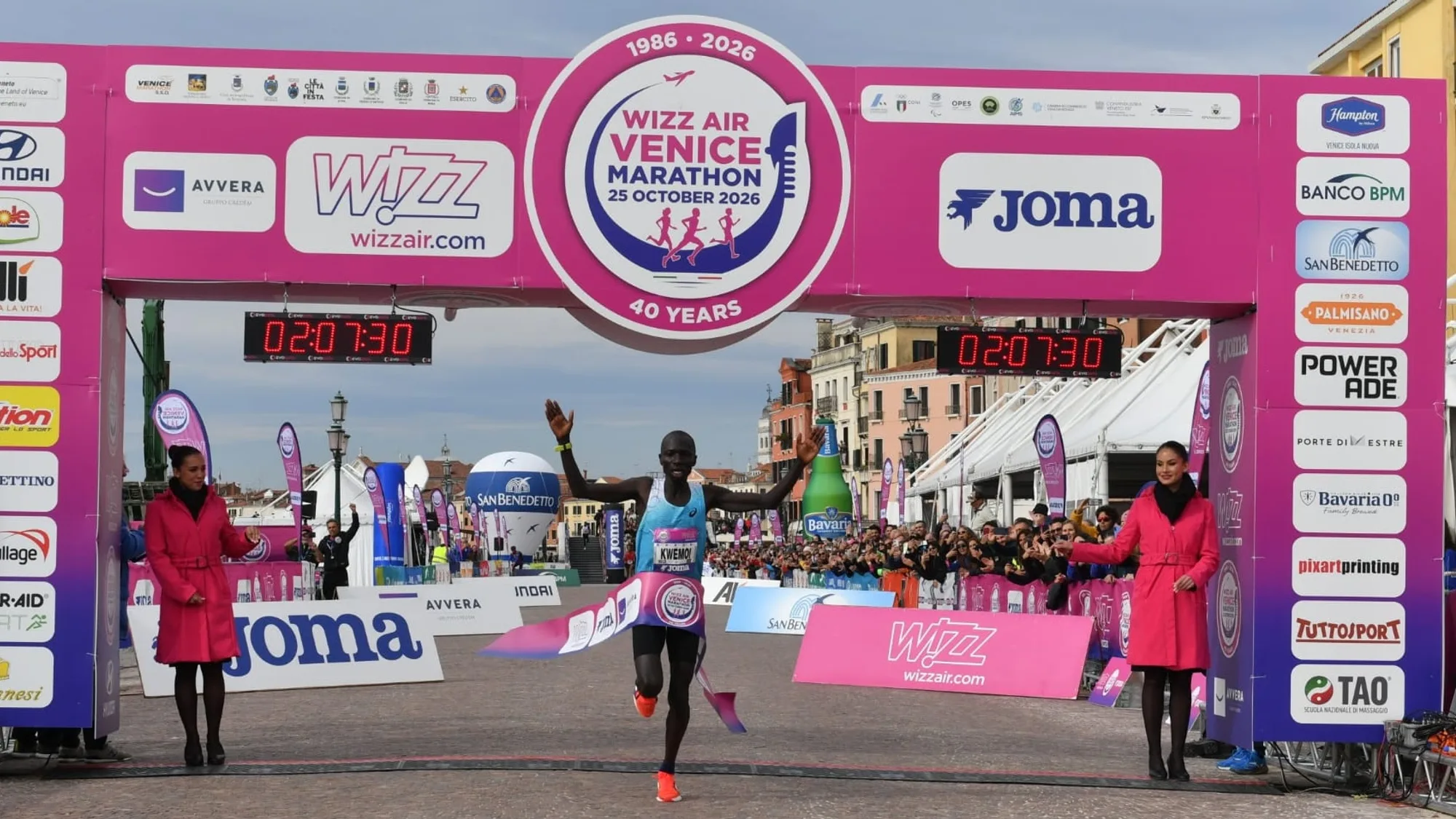
It was also fast. Kenya's Peter Kwemoi Ndorobo won in a course record of 2:07:31, with three men under 2:08, and Jackline Jerono won the women's race in 2:26:16, the third-fastest women's time in the event's history.
The partner list reads like a travel itinerary. Wizz Air is the title sponsor, and its communications manager linked the deal directly to the growth of the airline's Venice base, bringing more people closer to the city. Hampton by Hilton Venice Isola Nuova is the official hotel, Runna by Strava the official training partner, and Joma, the technical sponsor, designed the anniversary shirt and shoe around the Lion of Saint Mark. The podium trophies are Murano glass. New this year was a post-race medal party aboard a historic Venetian galleon in the lagoon.
What it means for destinations and brands.
Venice does not need a marathon for awareness. What the race gives it is control over where and when people go. The course is, in effect, a route plan for the metropolitan area: it puts thousands of runners, and the people travelling with them, in Brenta villages, in Mestre and in Marghera before it lets them anywhere near San Marco. The mayors of Stra and Fiesso d'Artico were at the press conference for a reason. A race is one of the few products that can move a visitor through a region in a fixed order, on a fixed date, and make them grateful for it.
The international split says something too. If the marathon is 70% foreign and the three races together average 55, the shorter distances are more local. For a destination, the long distance is the tourism product: it is the one people fly in for, and it is the one that should carry the travel offer, the hotel deals and the story of the region.
For brands, the sponsor list shows the whole visitor journey sold as separate partnerships. An airline brings people in, a hotel keeps them, a training app prepares them in the months before, and a kit brand makes something that only exists because of this city. Joma's lion shirt is a small example of a large point: product that belongs to a place travels home in a suitcase and gets worn long after the race.
The measurement is worth noting. The 15 million euro figure is an estimate, and the organisers have said a study will follow. That is the right order. A destination that funds a race should ask for the same thing in writing: a number before, a study after, and the method agreed in advance.
What we would do with a race like this.
We would treat the course as the brief. A race that starts among the villas of the Brenta and finishes at San Marco already contains the story a regional tourism body would pay to tell: the part of Venice that is not the islands. The content plan follows the route, not the finish line.
In practice that means one agreement covering four parties. The destination, here the region beyond the lagoon, sets what it wants seen and when. The event gives access to the start, the course and the moments that only it controls, such as the floating bridge. A brand with a reason to be there, whether that is travel, kit or recovery, supplies product that gets used rather than displayed. And athletes and creators from the source markets the race already draws from run it and document the trip: arriving, staying on the Riviera, racing, and the days after.
We would shoot the slow material in the week before, when the Brenta villas and Mestre can be filmed properly, and leave race day to the race. And we would tie the content to the economic study, so the region can see what the story did alongside what the weekend did.
None of this needs Venice. Plenty of smaller cities have a race whose course already runs through the places they want visitors to find. Most of them treat it as a sports event. It is also a route plan with a date on it.
If your region has a race like that and wants to use it as more than a weekend, we are happy to talk it through.
Source: venicemarathon.it